Industrial Real Estate FAQ
Straight answers to the questions Inland Empire owners and tenants ask us most — from NNN leases and BOVs to dock doors, IOS yards, and deal timelines.
What does an industrial tenant rep broker do?
A tenant rep broker represents the company looking for space, not the landlord. That means surveying the whole market (including off-market and coming-available buildings), qualifying candidates against your operational needs — clear height, power, loading, yard, zoning — negotiating the lease economics and terms against comparable deals, and managing the transaction to signature. In almost all cases the landlord pays the brokerage commission whether or not you have your own representation, so an unrepresented tenant is simply negotiating alone against a professionally represented owner.
How is industrial rent quoted in the Inland Empire — NNN vs gross?
Inland Empire industrial rent is typically quoted in dollars per square foot per month. A triple-net (NNN) rate is the base rent only: the tenant also reimburses property taxes, insurance, and common-area maintenance as additional charges. A gross (or modified gross) rate bundles some or all of those costs into one number. This means a lower NNN quote can cost more all-in than a higher gross quote — always compare total occupancy cost, and ask for the current NNN expense estimate in writing before comparing buildings.
What is a BOV (Broker Opinion of Value)?
A Broker Opinion of Value is a broker’s written estimate of what a property would sell or lease for in the current market, built from closed comparable transactions, active competing listings, and property-specific factors like condition, zoning, and yard. It is not a licensed appraisal — it is faster, usually free, and grounded in live deal flow rather than formulas. Owners use BOVs to decide whether to sell, refinance, or hold, and to set a defensible asking price. The Mudge Team prepares BOVs from its own Inland Empire comp database.
What is the difference between dock-high and grade-level loading?
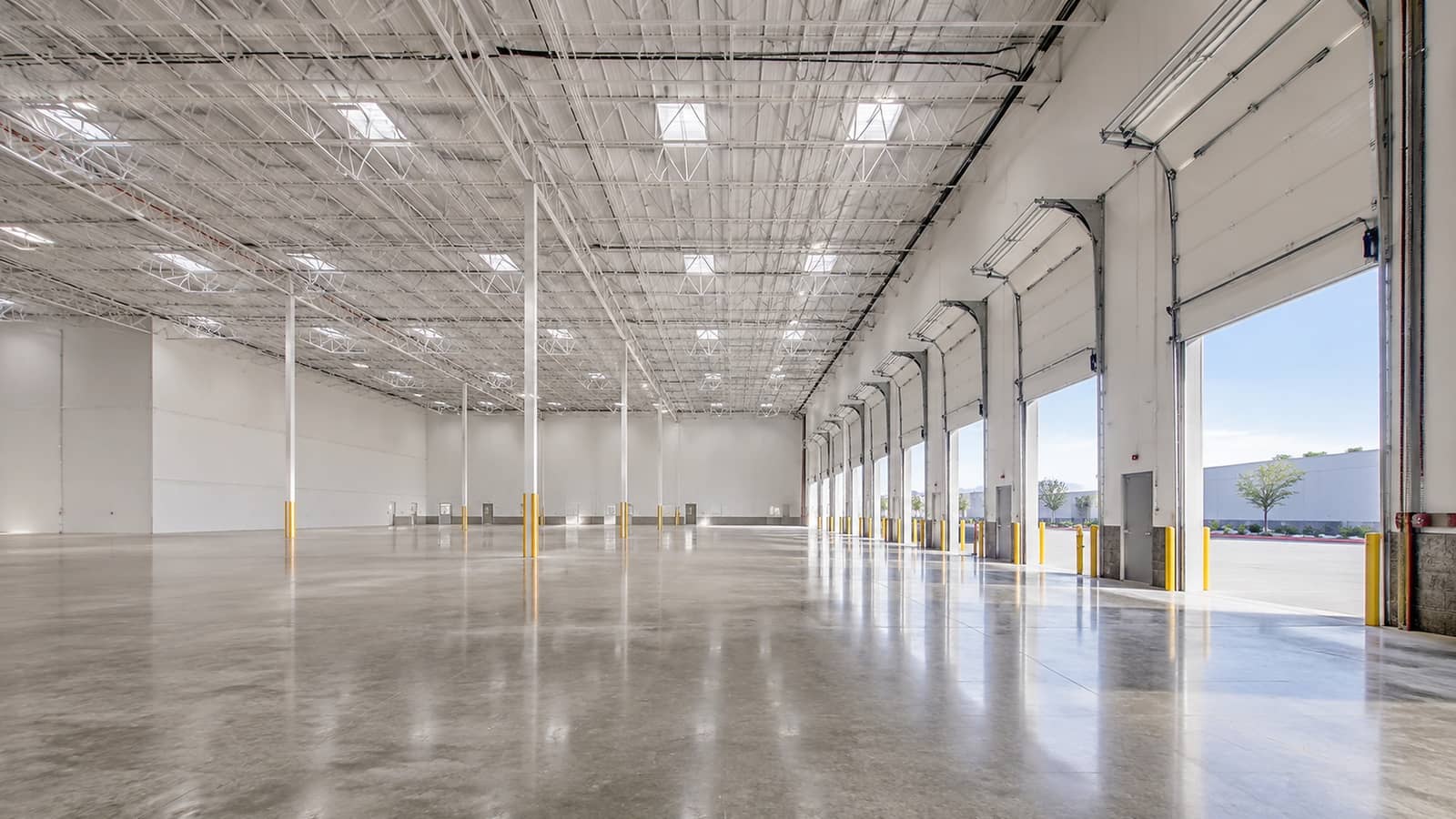
A dock-high door sits roughly at trailer-bed height, so a semi-trailer backs up flush and freight moves straight in and out on a forklift or pallet jack — essential for high-volume distribution. A grade-level (ground-level or roll-up) door is at ground height: vehicles and forklifts drive directly in, which suits service businesses, contractors, and light manufacturing. Many users need both. When touring, count the doors, but also check apron depth and truck court dimensions — a dock a full-size trailer cannot actually reach is worth little.
What is clear height and why does it matter?
Clear height is the usable vertical distance from the warehouse floor to the lowest overhead obstruction (typically joists, sprinklers, or lights) — the height you can actually rack to. It drives cubic storage capacity: the same footprint stores far more product at 32 feet clear than at 18. Modern big-box distribution buildings are built tall for racking density; older mid-bay buildings are lower, which is fine for manufacturing, service, or lower-volume storage. Match the height to your racking plan, and remember sprinkler design can limit storage height independently of the structure.
What is IOS (Industrial Outdoor Storage)?
Industrial Outdoor Storage is land used to store things outdoors — trailers, trucks, containers, equipment, pallets, building materials — usually fenced and paved or compacted, often with a small building for office or maintenance. Demand comes from trucking, drayage, logistics overflow, contractors, and equipment rental. IOS has become one of the most supply-constrained niches in the Inland Empire, because most cities now restrict where yards can operate and new entitlements are difficult. Value turns on zoning and permit status more than on any physical feature of the site.
What is a CUP and when does a yard need one?
A conditional use permit is a city approval allowing a specific use — truck parking, outdoor storage, trucking operations — on a specific parcel, with conditions attached, in a zone where that use is not automatically permitted. Many Inland Empire cities require a CUP for yard uses even on industrially zoned land. A yard operating without the right entitlement carries real risk of enforcement, and a yard with an approved CUP carries real scarcity value. Before buying or leasing yard property, verify the permit status with the city — never assume the current use is legal simply because it exists.
How long does it take to lease industrial space?
For a straightforward requirement in an available building, plan on several weeks to a few months from first tour to occupancy: touring and shortlisting, proposal and counter rounds, lease drafting and review, then any improvements and permits before move-in. The timeline stretches when the requirement is specialized — heavy power, food-grade improvements, yard entitlements — or when the space needs construction. The most common self-inflicted delay is starting too late; tenants with expiring leases should be in the market well before expiration to preserve negotiating leverage.
How long does it take to sell an industrial building?
A realistically priced Inland Empire industrial building typically goes under contract within a few months of hitting the market, followed by an escrow period covering due diligence, financing, and closing — often 30 to 90 days depending on the buyer’s loan. SBA-financed owner-user purchases usually take longer in escrow than cash or conventional deals. Total timelines run several months end to end. Pricing is the biggest variable: well-priced buildings in scarce segments draw multiple offers quickly, while overpriced listings sit and go stale. A broker opinion of value before listing is the cheapest insurance against both outcomes.
What should I check before leasing a warehouse?
Beyond rent: power (amps, voltage, phase — confirm against your equipment needs), clear height and column spacing versus your racking plan, dock and grade doors plus real truck access, sprinkler system rating versus what you store, zoning and any permit requirements for your specific use, and yard or trailer parking rights. Also read the operating-expense provisions closely in a NNN lease — roof and structural responsibility, capital expenditure pass-throughs, and management fees vary widely between landlords and materially change total cost.
What is the difference between asking rent and effective rent?
Asking rent is the landlord’s quoted number. Effective rent is what you actually pay averaged over the lease after concessions: free-rent months, tenant improvement allowances, moving allowances, and escalation structure all change the real economics. In softer markets, the gap between asking and effective can be substantial — landlords often protect the face rate for appraisal and lending reasons while competing through concessions. This is a core reason comparable-deal knowledge matters: the advertised rates on flyers tell you what owners hope for, while closed deals tell you what the market is really paying.
Do I need a broker to sell my industrial building?
You can sell without one, but you would be marketing into a market you cannot fully see. A broker exposes the property to the complete buyer pool — owner-users, investors, 1031 exchange buyers, and the principals behind unsolicited postcard offers — which is what creates competitive pricing. The direct offers owners receive by mail are usually calibrated below market precisely because they are designed to avoid competition. At minimum, get a broker opinion of value before responding to any unsolicited offer, so you know what the building is actually worth.
What are the major freight corridors in the Inland Empire?
The I-10 and the 60 carry east–west freight, including drayage from the ports of Los Angeles and Long Beach; the I-15 is the primary long-haul route north to Las Vegas and the Intermountain West and south to San Diego; and the I-215/91 spine ties Riverside, Moreno Valley, and Perris into the network. Rail matters too: BNSF and Union Pacific intermodal operations around San Bernardino and Jurupa Valley, plus air cargo at Ontario International Airport. Proximity to these corridors is a primary driver of industrial rents and land values across the region.
Market questions are local questions
The right answer usually depends on the submarket. Start with the city you operate in: